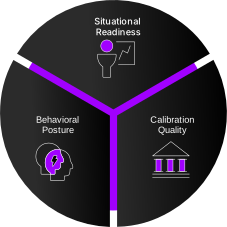
Before a single session begins, we calibrate the experience using the NegoTek ® Assessment—our proprietary diagnostic tool designed to uncover negotiation readiness at both the individual and team level.
Why? Because the data is clear:
- 45% of negotiators default to reactive behaviours under pressure
- 3 in 4 teams show internal misalignment across negotiation phases
- 20–30% margin leakage is directly linked to poor fallback discipline
Each participant receives a personalized profile assessing four critical domains that directly affect both deal outcomes and enterprise value:
1. Behavioural style under pressure
How you behave when the stakes shift—whether you hold posture or retreat to comfort.
2. Fallback discipline and escalation control
Do you hold the line or give it away? We assess how you govern concessions, terms, and when (or if) you escalate.
3. Negotiation phase fluency
How precisely you track and apply behaviours in each of the Kennedy 8-Step / Four-Phase Model—Preparation, Debate, Proposal, Bargain.
4. Strategic alignment with team posture
Where gaps exist between individual intent and team execution—and what that costs in trust, clarity, and margin.
This is not a personality test. It’s a behavioural calibration so we know where to intervene, and you know where to sharpen
There is a behavioural process underpinning every negotiation. We call it the 8 Step/Four Phase Approach ®
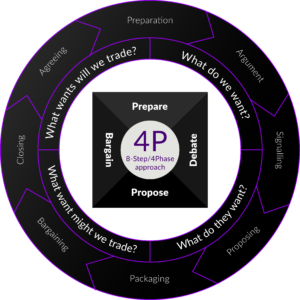
It is not a theory. It emerged from four decades of real-world application, tested across industries, cultures, and negotiation tables.
It does not matter where you are or who you face—friend or rival, novice or veteran—the sequence of behaviour remains constant. What changes is how you behave within it.
Knowing the process does not make you clever. Applying it when under pressure does. It gives you clarity about which phase you’re in, what behaviour fits, and when to switch. It stops you from improvising deals in the hope they’ll work, and instead helps you structure behaviour that does.
Control in negotiation doesn’t mean dominating the other party. It means not giving your power away by acting out of habit, fear, or misplaced goodwill. It means ma
naging your own behaviour—step by step—so that you negotiate, rather than concede.
Skills Based Workshop
Negotiation is not theory. It is a live, adaptive process that only improves with practice. That’s why our approach places participants in the thick of it—negotiating, testing, adjusting, and learning by doing.
More than 70% of course time is dedicated to structured, practical work. Not role-play for its own sake, but focused exercises that mirror real negotiation challenges what we call Case Plays.
Each exercise is led by an expert coach who doesn’t just observe, they intervene, correct, and prompt new behaviour on the spot. Participants are expected to try, reflect, and try again. This is not training to feel better. It’s training to perform better.
The workshop ends with 360˚ and one-to-one feedback, followed by a structured development report grounded in live behavioural data.
Each participant then works with their coach to translate this into a Personal Development Plan—not a wish list, but a clear set of priorities based on how they actually performed under pressure.
The aim is simple: correct what weakens outcomes, reinforce what drives results.
Each participant receives up to 120 minutes of expert coaching per year—typically delivered as two focused sessions. This is not generic advice. It’s direct access to the same coach who led their training and observed their behaviour live.
Whether preparing for a complex deal, pressure-testing strategy, or reviewing post-negotiation outcomes, this support ensures the skill is not just learned—but applied.
It’s included in the fee. No add-ons. No gatekeeping. Just real-time input when it matters most.
The learning doesn’t end when the workshop does. Negotiation is a skill that sharpens with pressure, repetition, and coaching—not just theory.
- Each participant leaves with a personal performance report and development plan—grounded in live observation.
- One month later, they receive a targeted call to reinforce key behaviours and correct early drift.
- At the three month mark, we run a focused one-day follow-up—built to pressure-test application, embed high-performance behaviours, and translate learning into measurable business outcomes.
After three months, participants return for a Negotiation Immersion Day—a high-intensity session built to simulate real pressure, reinforce behavioural control, and embed Kennedy-phase fluency.
The day is hands-on. Every activity is designed to expose gaps in discipline, test escalation posture, and push negotiators to apply what they’ve learned—under stress, not theory.
Think of it as a strategic stress test: part rehearsal, part refinement—delivered to hardwire negotiation skill into performance.
Training is only complete when it shows up in results.