Kennedys Negotiation

First-Level Negotiators

 8-Step Approach has directly impacted the way we work in our companies. It provides managers with a credible and simple negotiation tool that is very powerful

John Benson – Board Member


What separates competent negotiators from ineffective ones? It’s not charm. It’s not aggression. And it’s certainly not blind optimism. It’s discipline.

This foundational program dismantles outdated myths like being “win-win,” being tough, or simply knowing how to get to “yes.” Most negotiators operate in one of two flawed zones: RED over-assertive and concession-driven; or BLUE accommodating, risk-averse, and avoidant. Both are reactive. Both destroy value. RED negotiators win battles and lose accounts. BLUE negotiators keep the peace while leaking value.

12 delegates

1:12 Consultant Ratio

2 day course

Budget Friendly

12 Weeks Reinforcement

Train the Trainer Available

What you’ll achieve

Participants learn Kennedy’s 4-Phase Model and 8-Step Framework to develop structured, repeatable negotiation behaviour. Each phase demands deliberate preparation, structured conduct, and rigorous self-regulation.

  • Participants leave with a behavioural map—not just theory—but a repeatable model for planning, proposing, trading, and closing.

  • This training is simulation-heavy, designed to expose poor habits, enforce discipline, and establish behavioural consistency.

  • Participants learn to negotiate as a structured discipline using the proven “8-Step/Four Phase Model.”

  • They build disciplined behaviours explicitly practised—not assumed—at every negotiation phase.

  • Skills are pressure-tested through realistic simulations that expose bad habits, challenge complacency, and embed high-performance negotiation discipline.


This program is for you if:

You are a manager or executive seeking to develop structured, practical negotiation capability.


You want to ground yourself in the principles of Kennedy’s behavioural discipline before progressing to advanced applications.

Conceptual, Strategic and Behavioral

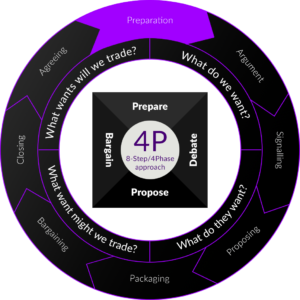
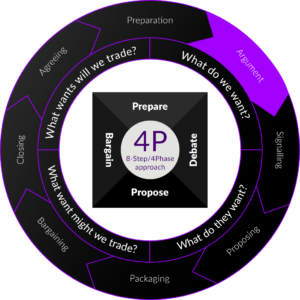
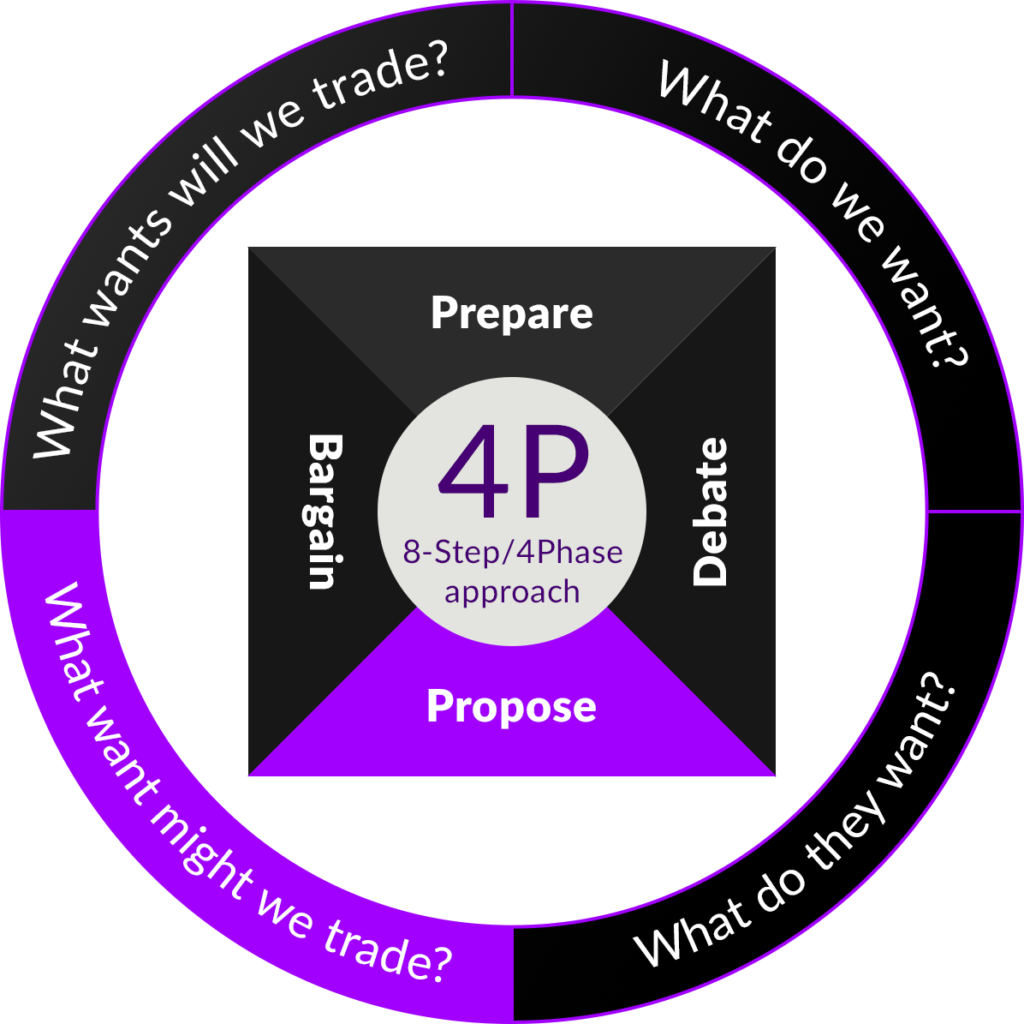
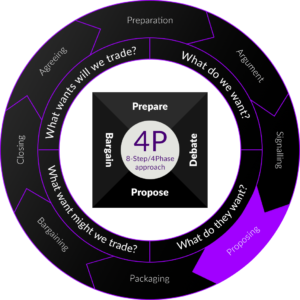
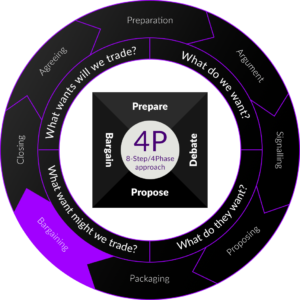
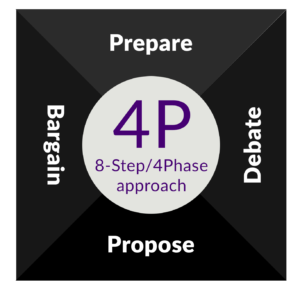
The Kennedy Method is built on a clear truth: negotiation doesn’t need to be improvised. It needs to be structured. At the heart of the method are eight behavioural steps, grouped into four focused tasks and phases: Prepare, Debate, Propose, and Bargain. These aren’t abstract ideas—they’re pressure-tested moves that guide negotiators from strategy to closure with clarity and control
  • The 4 phases are about where you are (conceptual and strategic) (
  • The 8 steps are about what to do (behavioral and detailed)

Each phase reflects how real deals unfold. Each step defines what skilled negotiators actually do under pressure—from how they prepare and signal, to how they package value and close firm agreements.

The structure isn’t rigid. It’s behavioural.
The steps don’t just describe negotiation—they drive it.

Because in Kennedy’s view, results don’t come from charm or consensus.
They come from disciplined movement through a deal—step by step, phase by phase.

Kennedy’s Strategic Deal Framework


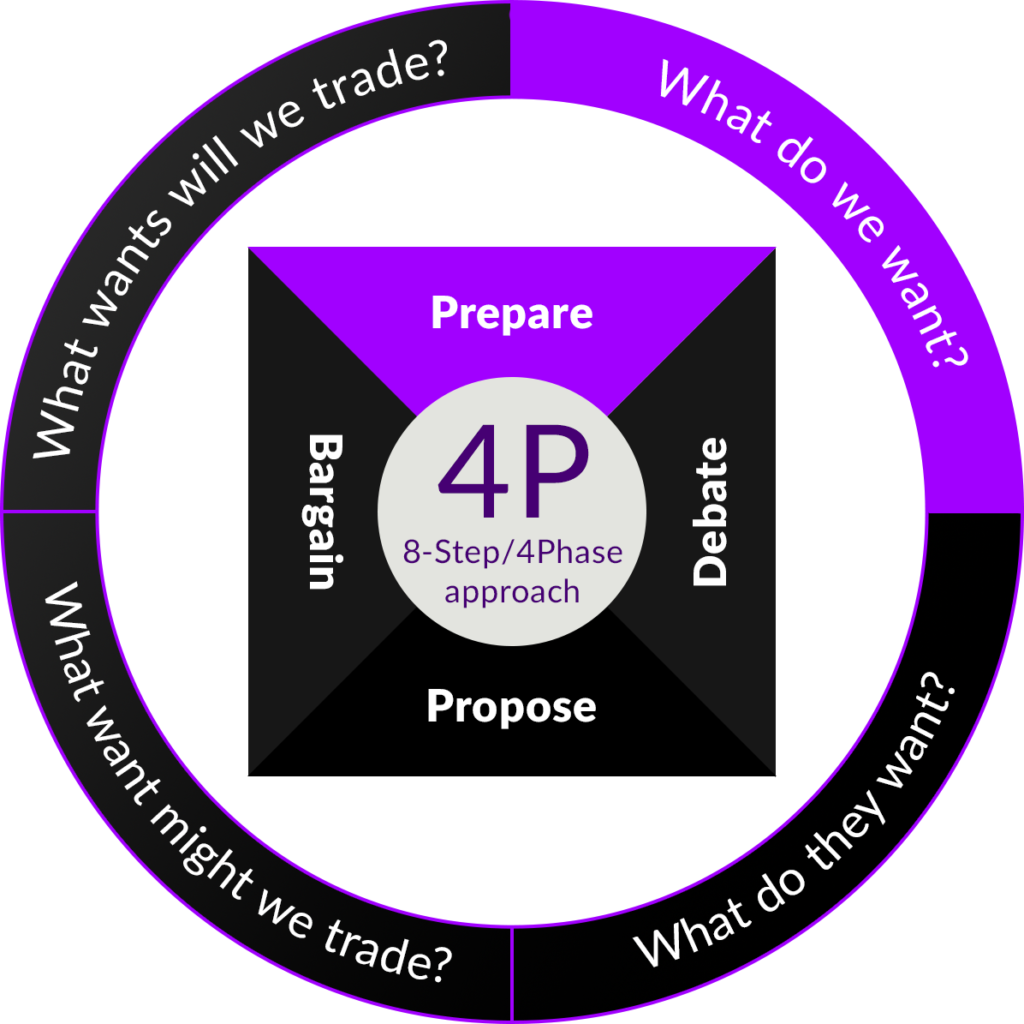
Phase: Prepare
Task: What do we want?

Phase: Debate
Task: What do they want?

Phase:Propose
Task: What wants might we trade?

Phase: Bargain
Task: What wants will we trade?
Negotiation as a Phased Process

Strategic thinking, internal alignment, tradable mapping.

Preparation is often the difference between a good deal and an average deal — or no deal at all

Task: What do we want?

This is where serious negotiators take control — before the room, before the pressure, before the first move.

Want to nail your next negotiation? It all starts before you even sit down. Think of preparation as your strategic advantage – the difference between a killer deal, a mediocre one, or walking away empty-handed.

Effective negotiators are masters of prep. They laser-focus on their goals, know their absolute limits (that walk-away point!), and are crystal clear on what they bring to the table. But that’s just the beginning.

The 8-Step Approach

The Prepare Step

The Kennedy method defines what the deal is really about, what matters most, and what you’ll never concede. You set your stance, pre-load your countermoves, and ensure your team speaks with one voice. It’s not about guessing their game — it’s about forcing them to play yours. Unprepared negotiators don’t lose by accident — they lose by design. Preparation isn’t optional. It’s the edge.
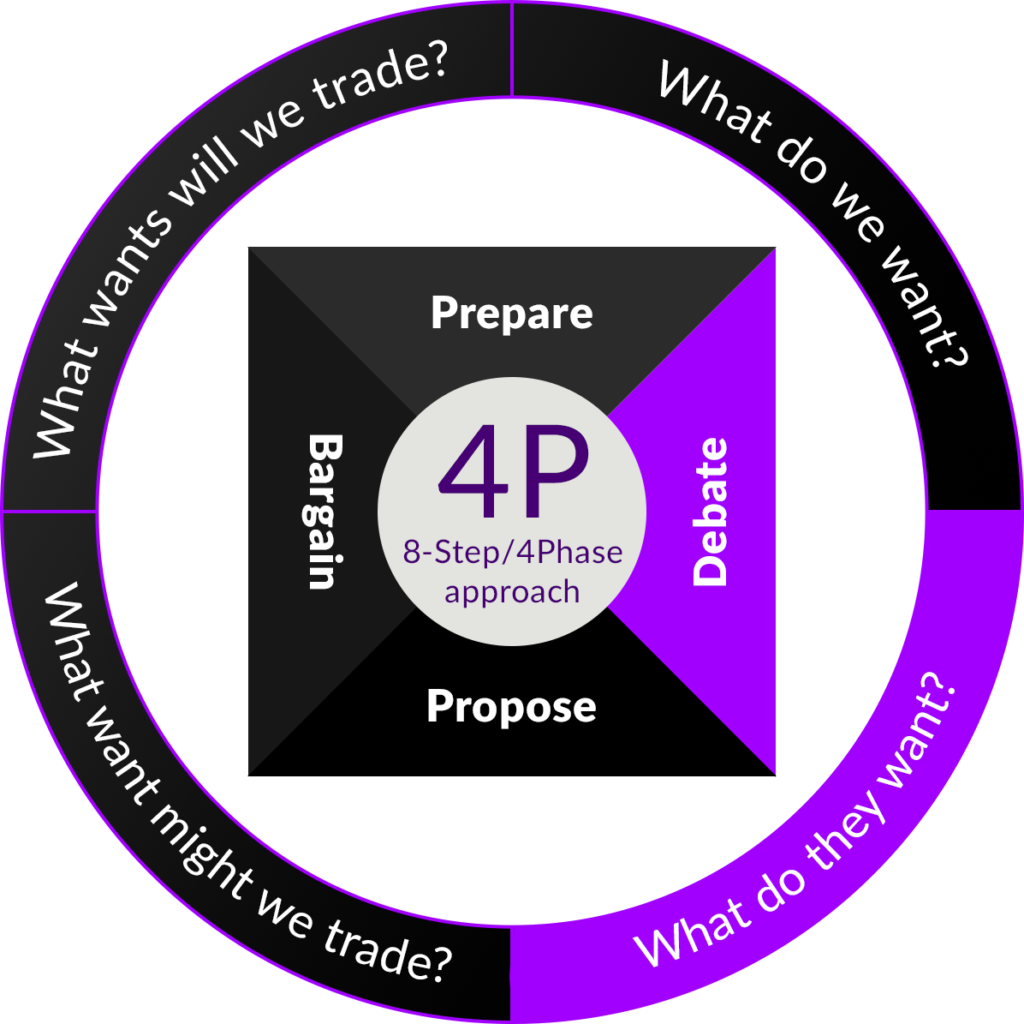
Negotiation as a Phased Process

Listening, testing assumptions, questioning

Mess it up here, and you're likely heading for disaster

Task: What do they want?

It’s disciplined discovery. Poor negotiators argue; effective ones uncover leverage

The real power comes from getting inside the other side’s head. What do they want? What are their likely moves? What arguments will they throw your way? By mapping out their potential goals, tactics, and reactions, you’re playing chess while they’re still figuring out the rules.


The 8 Step Approach

The Argue Step

Present your case and challenge assumptions — but avoid destructive behavior. Kennedy uses the term “argue” to reflect what people naturally do, but prescribes effective questioning and listening.

The Signal Step
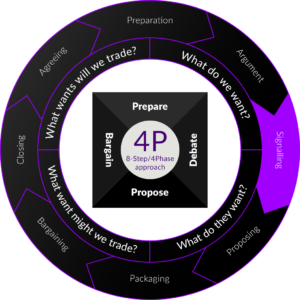
Indicate readiness to move without making commitments. Use tone, timing, and nuance to invite exploration. Signals are the bridge to proposals. If you ignore them… the moment for movement may not recur and the dispute may go into rigid deadlock

Negotiation as a Phased Process

Packaging, conditionality, and timing

This is where you begin to shape the deal

Task: What wants might we trade?

Ready to move things forward? The Proposing phase is where the action heats up. It’s about putting potential deals on the table – conditional offers designed to test the waters and uncover mutual wins.

Think of it as a strategic dance: “If you give us this, then we can consider that in return”. This is where you explore the possibilities, figure out what you can trade, and start shaping the final agreement before the explicit close.

The 8 Step Approach

The Propose Step

Nothing, absolutely nothing, is given away free. Everything… is conceded in exchange for something else

Every offer is a calculated move that signals, tests, and reshapes the field. Proposals are not commitments — they are instruments of movement. Weak proposals drift. Strong proposals shift the dynamic

The Package Step
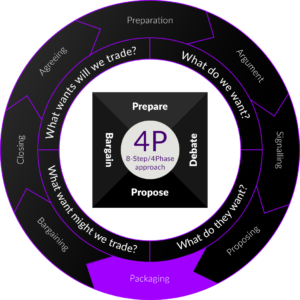
Packaging is about structure & dealing with proposals which have been rejected

Single-issue bargaining gives way to issue bundling. Negotiators combine multiple elements into tradeable packages to increase the chances of mutual gain.
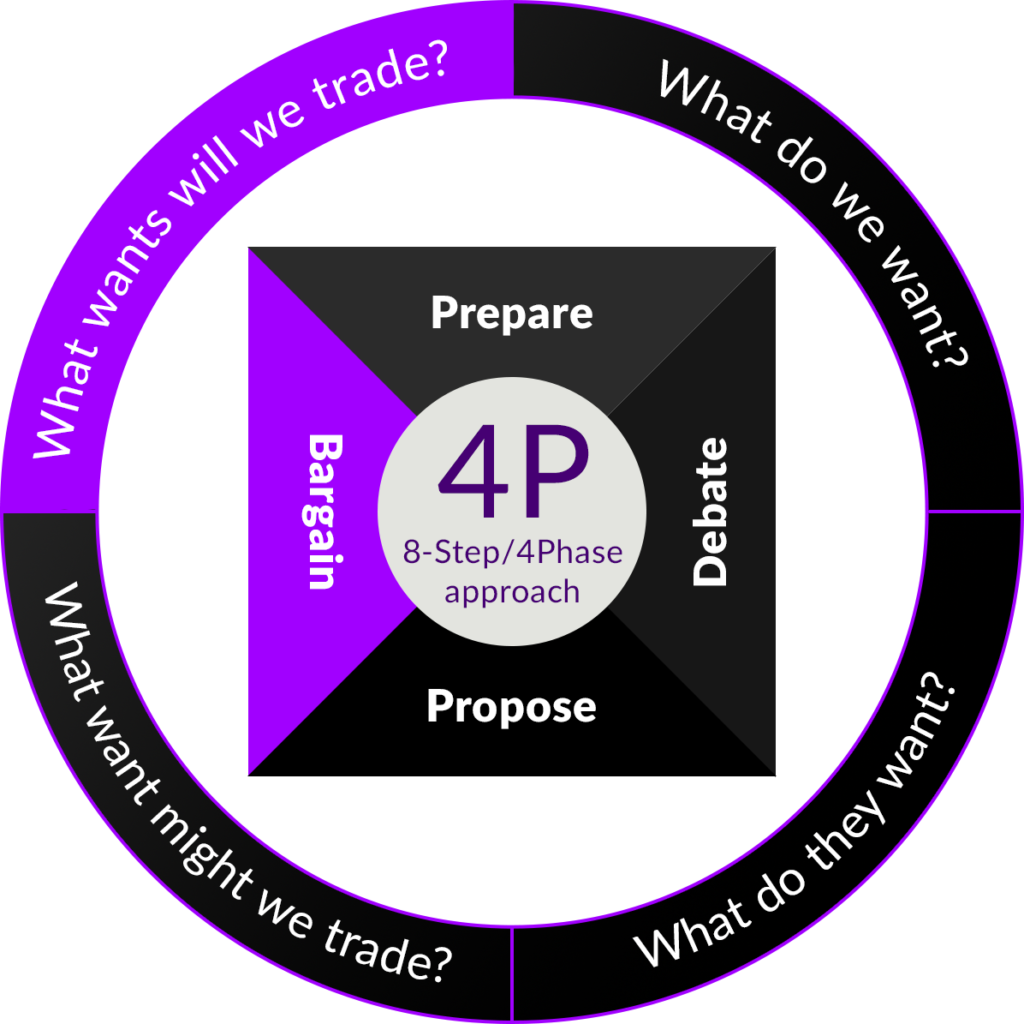
Negotiation as a Phased Process

Concession management, closing discipline, and counter-move readiness

Closing ploys tend to be pressure ploys. and Momentum is building up towards agreement

Task: What wants will we trade?

Bargaining is a search for agreement within ranges of acceptable terms. It includes testing limits, trading, and adjusting packages. This is the final act — where intentions are tested and weakness is punished

Bargaining is precise, conditional, and unforgiving. There is no improvisation — only designed exchanges. You trade, you test, you close.

No concessions are made without returns. No moves are made without intent. This is not where you find the deal. This is where you secure it — on the best terms they’ll accept.

The 8 Step Approach

The Bargain Step

The finish line is in sight! Bargaining is where you fine-tune the details, bridge those last remaining gaps, and make the final trade-offs that lead to agreement. You can feel it – a deal is within reach!

The Close Step
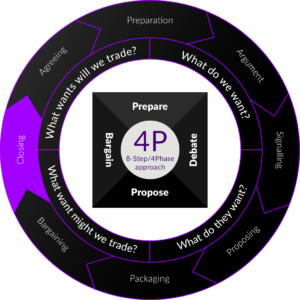
Don’t let victory slip away. Leaving the table without a signed agreement is risky business. This is the moment to lock it in, finalize the terms, and close with confidence.

The Agree Step
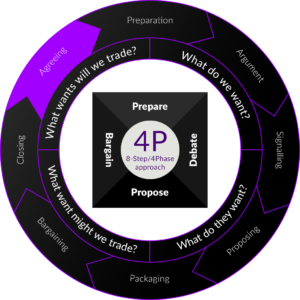
As the agreement comes together, the tone often shifts. The focus turns to making it work: clear implementation, anticipating potential bumps, and ensuring everyone is on the same page. Get it in writing, seal the deal, and move forward with certainty!
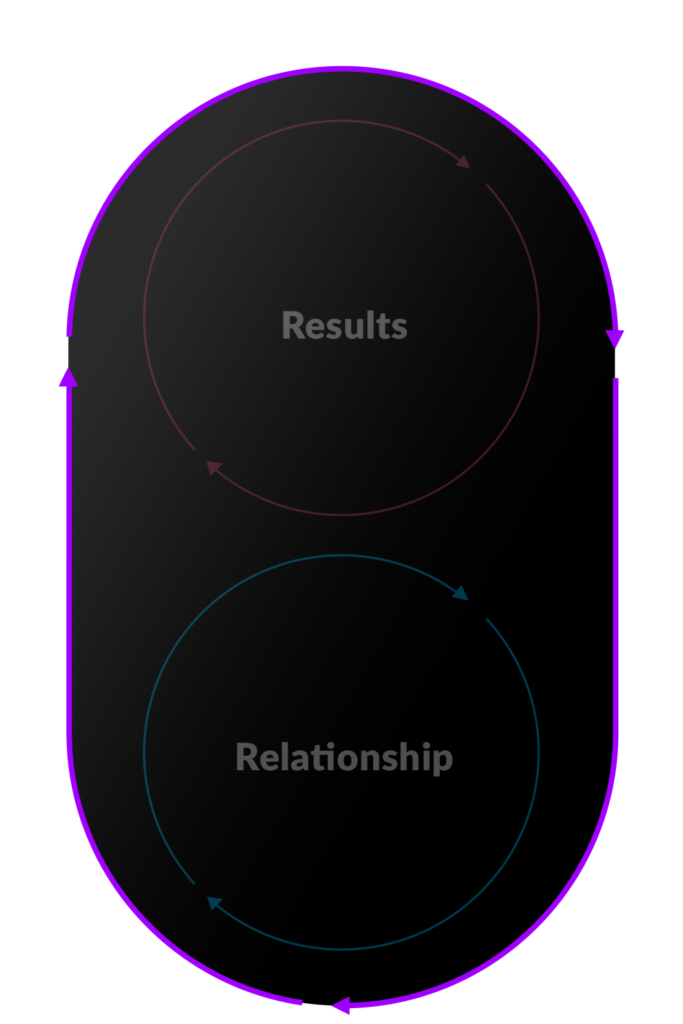
 Negotiation is the ratio of

What we want


What they want

Strategic Imperatives

Collaboration Strengthened
Culture Alignment
Performance Elevated
Decisions Unified

Successful
Execution

Red Style: Dominate or Destroy (But at What Cost?)

Red style is not solely a set of behaviours. It is an intention to benefit at your expense

Strategic Imperatives

Collaboration Strengthened
Culture Alignment
Performance Elevated
Decisions Unified

Successful
Execution

Purple Style: The Art of the Deal - Balanced & Brilliant

Want consistent wins? Purple negotiators are the masters. They understand the game: nothing is given without getting something back. That’s the core of the Purple Principle – balanced, strategic, and consistently high-performing.


Want to close more deals, concede less, and forge agreements that stick?

Then aim to be a Purple negotiator. They consistently outperform the rest.

Purple behaviorists fuse their red demands with their blue offers in a conditional purple format: ‘If you give me what I want, then I can give you what you want

Scroll to Top